Urban Canopy Works
  • Home
  • About Us
    • Our Work
  • We Can Help
  • Tree Canopy 101
    • Services of Urban Trees
    • Trees as City Infrastructure
  • News & Events
  • Contact Us

Boston, MA

Urban Forest Plan

Boston Urban Forest Plan (2022)


​PROJECT OBJECTIVE

Boston is facing significant challenges over the next decades, including:
  • Climate change
  • Rising cost of living
  • Development pressures
  • Growing population
  • Inequitable tree canopy distribution
  • Historic and ongoing disinvestment and marginalization or some neighborhoods
The Urban Forest Plan (UFP) was launched in 2021 to work on addressing many of these challenges, and was called for specifically in the Climate Ready Boston, the City’s initiative to prepare for the near- and long-term impacts of climate change.  The UFP is also a part of the City of Boston’s Healthy Places initiative, a coordinated effort between three plans, this UFP, Heat Resilience Solutions for Boston (the Heat Plan), and the Open Space and Recreation Plan, to build a safe, healthy, resilient, and accessible city for everyone in a changing climate.

STATS DURING PLAN DEVELOPMENT

Latest Tree Canopy Assessment:     27% as of 2019
Public Tree Inventory:   More than 40,000 public trees, collected in 2021
Population:  Approximately 700,000
City Area:   89 square miles

PROCESS

UCW was hired as part of the Stoss Landscape Urbanism team to analyze data and engage with the citizens of Boston to co-develop a plan. A 71-member Advisory Group was formed, ​and multiple working meetings were held to assess the condition of the existing urban forest and determine priorities for the community.  An Equity Council was also created, composed of 24 representatives from grassroots community-based organizations in historically excluded and marginalized communities. This council was formed to provide a structure that centered the voices of these communities, and was ultimately assigned . The project team met regularly with these groups throughout the process and they have guided the plan’s direction. An internal operations review was conducted, along with a comprehensive review of the existing policies, plans, data and codes. UCW’s approach to this project from the beginning was to be thorough, inclusive, and flexible. 

OUTCOME
​

With the plan completed in 2022, Boston had its first roadmap for managing the urban forest.  This is a plan for the entire community - both public and private landowners.     Four goals were set by the Equity Council, with 7 strategies described in detail to work toward those goals.  

Goal 1: Equity First. Focus investments and improvement in under-canopied, historically excluded and socially vulnerable areas.

Goal 2: Proactive Care and Preservation. Ensure trees/tree canopy are proactively cared for.

Goal 3: Community-Led. Ensure community priorities drive urban forest decisions and management.

​Goal 4: Prioritize and Value Trees. Increase awareness and buy-in regarding the importance of trees in Boston across the public and private sectors.

Working toward these goals will require a significant effort by all stakeholders, both private and public.  7 Strategies were defined to work toward these goals, each with multiple action items described in the full plan.  

  • Strategy 1: Expand and reorganize urban forestry management
  • Strategy 2: Proactively protect and care for existing trees
  • Strategy 3: Strategically and equitably expand canopy
  • Strategy 4: Make space and improve conditions for trees
  • Strategy 5: Improve communications - both process and content
  • Strategy 6: Improve information collection and sharing
  • Strategy 7: Build and support a local tree workforce

Implementation. Since the plan's completion in 2022, Mayor Michelle Wu’s fiscal year 2023 budget took a major leap forward by including 11 additional staff positions for the Tree Division. Another $2.5 million from the American Recovery Protection Act (ARPA) will be used to decrease the wait time on street tree pruning by employing additional tree crews in the field. Funds will also be used to start a pilot program for residents willing to plant trees on their private residential properties. The City will collaborate with a local nonprofit to run this initiative where residents will have a tree planted on their private property to help increase the overall canopy. In Spring 2022 PowerCorpsBOS was launched, a Cityrun workforce development program for youth aged 18 to 30 years old. This program will help provide pathways for more diverse candidates to enter into the urban forestry field and gain the skills needed to excel in this field. These resources are a critical step in transitioning to a proactive tree program.
View Boston Urban Forest Plan project website
Implementation Updates

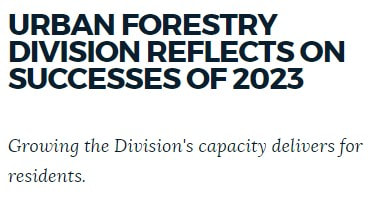
Since the plan's completion 2022, Boston was immediately able to begin implementing changes, including adding 10 additional staff positions (tripling their current capacity) to the forestry division, beginning work for increased Emerald Ash Borer outreach, changes to tree protection ordinances, and much more.  Click on the headlines below for updates on progress from the City.
Picture

Picture
Picture
Picture
​
If you're interested in seeing how a strategic urban forest or master plan can help you start discovering your forestry goals and develop strategies on how to reach them, please contact us.
Urban Canopy Works, LLC | Contact Us | © 2026
Picture

​UCW is proud to support:
Picture
Picture
  • Home
  • About Us
    • Our Work
  • We Can Help
  • Tree Canopy 101
    • Services of Urban Trees
    • Trees as City Infrastructure
  • News & Events
  • Contact Us